Fine-grained provenance, Automerge updates, LIVE workshop

We hope you’re having a great Fall! In this Dispatch we’re sharing explorations of new editor interactions for writing science papers, a trio of projects advancing the future of Automerge, and links to some recent presentations about our work.
Fine-grained provenance
In a prior Dispatch we introduced
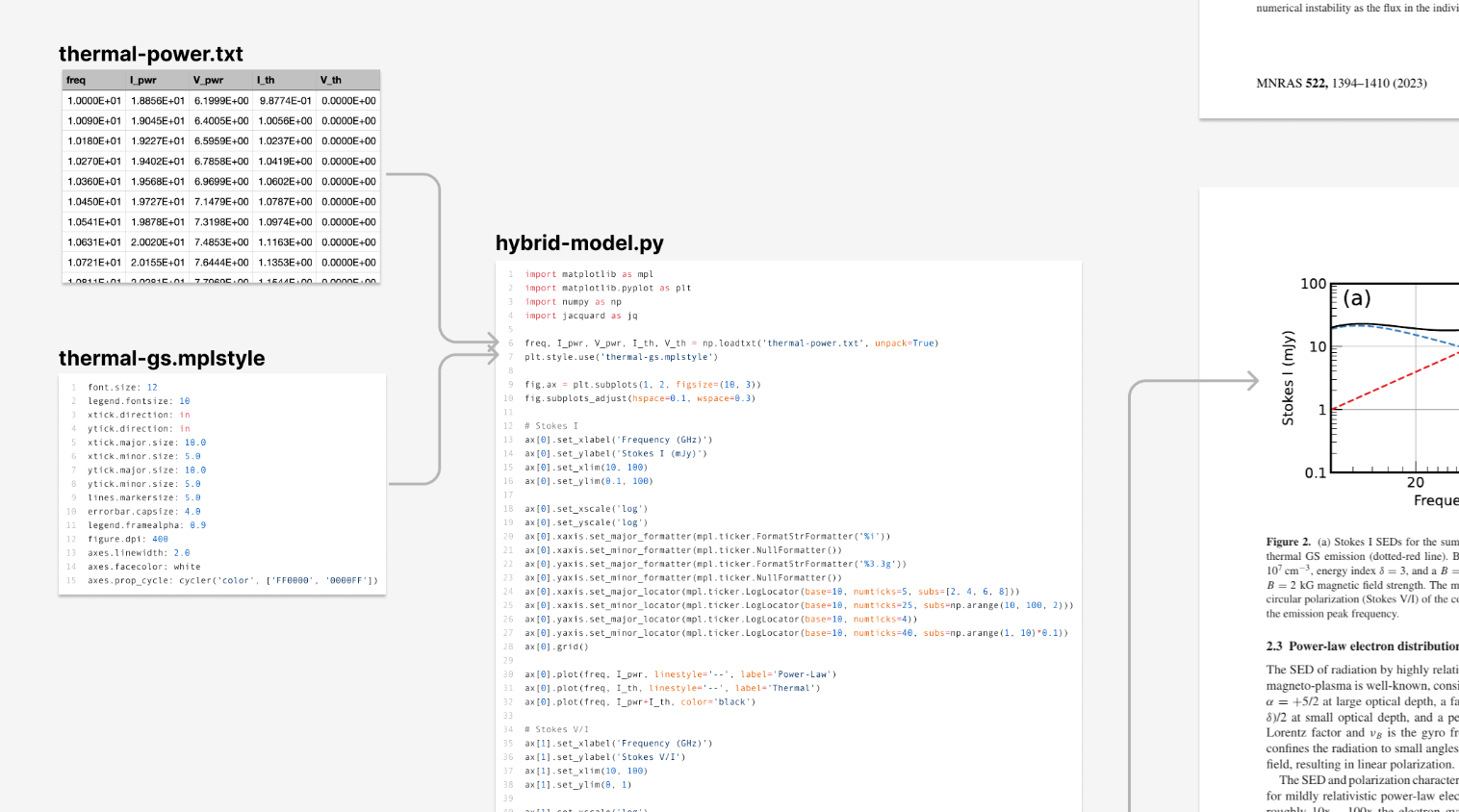
Lately, we’ve been exploring the theme of fine-grained provenance: connecting specific parts of one file with corresponding parts of another file. We’ve been trying out some new UI interactions that take advantage of this provenance information, such as:
- mirroring comments between a PDF and source text file
- allowing users to edit underlying source text directly from a rendered PDF
- using provenance information as a “map” of a project
Based on our own tests and some conversations with scientists, we’re feeling that there’s a promising path here towards more fluid editor interactions. We’re also thinking about how it might work to have fine-grained provenance information available as a core primitive in an operating system.
To see some video demos, take a look at our lab note on fine-grained
Automerge updates
It’s been a summer of change for
- Memory usage: Orion Henry is working on drastically reducing memory usage. He’s taking the columnar encoding already used to store Automerge documents on disk, and using it at runtime. This project is at the correct-but-slow stage right now.
- Multi-document sync: Alex Good is working to build a new sync protocol which doesn’t require the document to be in memory, works over encrypted documents, and enables syncing collections of documents more efficiently.
- Auth: Brooke Zelenka is leading the Beehive project, which implements end-to-end encryption and local first authentication + authorization for Automerge (and hopefully other systems as well).
For a deeper dive, you can watch the video recording of the
LIVE 2024 presentations
Last week, many of us attended LIVE
- Ivy Reese and Alex Warth presented Inkling, Sketching Dynamic
Systems , a system for sketching with constraints developed at Ink & Switch together with Marcel Goethals. - Marcel Goethals presented Subsequently: Telling stories with pictures makes
programs , a visual programming environment inspired by comics. - Researcher-in-residence Elliott Evans presented Live Programming a Live Programming Environment: An Experience
Report , work done together with Philippa Markovics, Martin Kavalar, Andrea Amantini, and Jack Rusher on developing a live programming environment using the Clerk live programming environment. - Researcher-in-residence Lu Wilson presented Arroost: Unblocking creation with
friends . They’ve also given several other talks in the pastmonth ; check out What it means to beopen which has been provoking some good discussions about process within the lab.
We also recommend the keynote presentation by Jonathan Edwards: The Meaning of
You can see all the talks from LIVE in the full video recording of the
Malleable Software in the Age of AI
Lab researcher Geoffrey Litt recently presented Malleable Software in the Age of
In addition to demos of the dynamic document environments
What’s a few more open tabs?
- We’ve been enjoying digging through the Dynamicland
archive from Bret Victor and team. - Jamie Brandon’s
HYTRADBOI conference is happening again on Feb 28, 2025. We enjoyed the last one! Gridfinity : for the organization nerd in your life.
That’s it for now — until next time.