Automerge 3.0 Beta, Sketchy Calendar, and a lab website refresh

This month’s update spans the full range of work we do at Ink & Switch. We have some major updates to our open-source Automerge library, an introduction to Sketchy Calendars, and a peek at our ongoing work on collaboration tools for game development. We’re also excited to share a refreshed website for the lab and a talk by our director about how we work.
New Automerge releases
We’ve recently released some major updates for
Automerge 3.0 Beta: Automerge 3.0 is an architectural overhaul that radically improves performance. Historically, Automerge compressed large histories on disk, but didn’t use the compressed format in memory. For this release, Orion Henry re-implemented Automerge to use the on-disk columnar compression format in memory; the result is memory savings of 100x in some cases, and much faster document load times. We’re seeing huge benefits in our internal deployments!
Alongside the performance improvement, we’ve also taken the opportunity to do a major version bump and fix some awkward parts of the API which were a result of maintaining backwards compatibility.
This is a big change, so we’re rolling it out slowly. We’ve run fuzz tests and have been successfully using it internally; we’ve also been working with the Automerge community to make sure it’s stable and fast in their usage. We’re confident enough now to release a beta. Please kick the
Automerge Repo 2.0: We have also released a new major version of Automerge Repo, the networking and storage adapter library for Automerge. We’ve cleaned up APIs to require less boilerplate, improved handling of asynchronous loading states, made progress reporting better, added more convenient helpers for history and diffing, and more. See the announcement blog
Sketchy Calendar
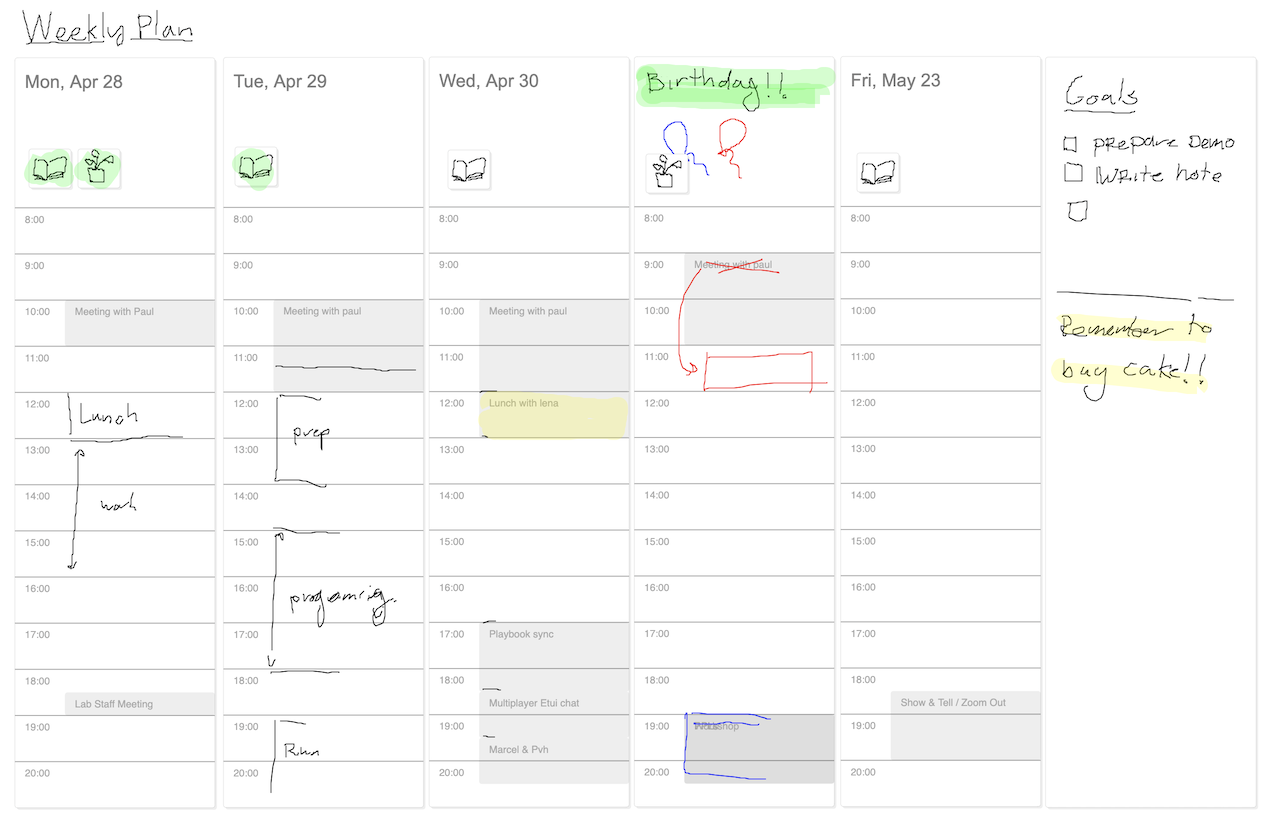
When it comes to calendars, you can choose between using a digital calendar app or getting a paper calendar. They both allow you to keep track of things like doctor appointments, work meetings or birthdays, so you can keep a clear head and be sure that you won’t forget anything. But while the two approaches may seem similar on the surface, they’re radically different in the kinds of trade-offs they make.
Lab researchers Marcel Goethals and Paul Sonnentag have begun exploring what it would mean to have a calendar that combines the convenience of a digital calendar with the simplicity and expressivity you get from pen & paper. Find out more in their introductory lab
Seeking Godot game devs
Over the past few months, we’ve been working with the Endless
Here’s a sneak preview:
We’re now seeking people with Godot game development experience to test out an early prototype. Sign up
Website updates
We recently shipped a major expansion to the Ink & Switch
In addition to our essays and lab notebooks, you’ll now find landing pages for our four primary research areas—local-first software, programmable ink, malleable software, and universal version control—each sporting a newly designed logo. On these landing pages you can learn more about the ongoing themes present across our work, and then dig deeper into summary pages for each of our projects, some of which are being shared publicly for the first time.
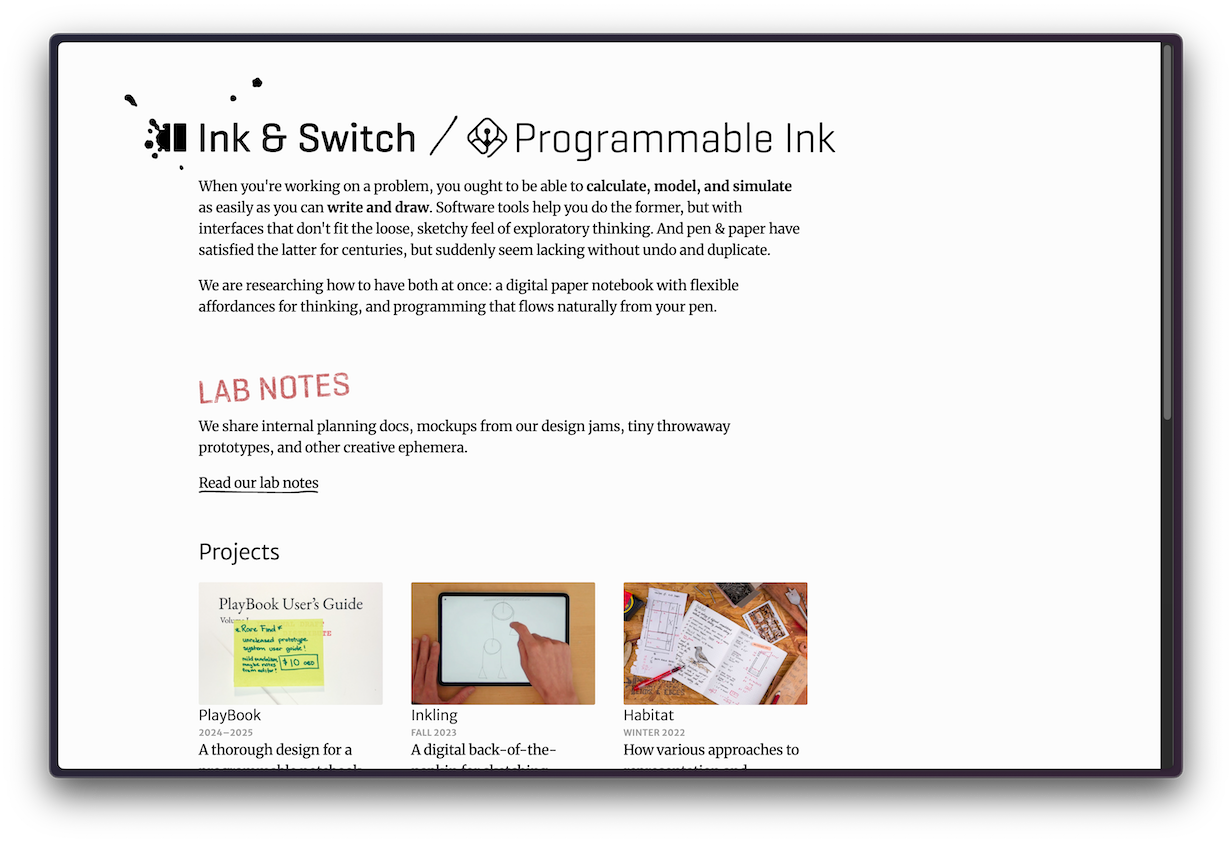
On our home page, you’ll also find a sampling of upcoming events and appearances by our researchers, and — answering one of our most frequently-asked questions — information about how our research is funded and how you can get involved.
This update goes a bit deeper than just the launch of new pages. We’ve also replaced our old site engine, Hugo, with a new system developed in-house that makes it easier for us to experiment with new ideas for the form and content of the site. Our notebook for Programmable
So set aside some time to browse around and see what’s new, and subscribe to our RSS
How to Do Ambitious Research in the Modern Era
We don’t often talk about how we work: we try to let our work speak for itself.
Still, if you’re the kind of person who finds the “behind-the-scenes” view of research interesting, you might enjoy this talk at the Nemertes [next]
If you’re interested less in the “how” and more in the “what” of cutting edge research, consider starting with Itai Cohen’s talk from the Nemertes conference about his group’s work on Electrically Integrated Autonomous Microscopic
That’s it for this month—until next time!